
Introduction
For more than two decades, finding information online meant typing a few keywords into Google, scrolling through a list of links, and choosing the page that looked most relevant. At this moment, that experience is evolving. Instead of searching with keywords, people are asking full, conversational questions to AI tools like ChatGPT, Perplexity, Claude, Gemini, and Microsoft Copilot, and they're receiving direct answers rather than a list of websites. This shift is changing how people discover businesses, products, and services.
Rather than simply linking to your website, AI-powered search engines summarize information from multiple sources and decide which brands to mention, how to describe them, and which sources to trust. That means your carefully crafted page titles and meta descriptions are no longer the only factors influencing how people find your business. Increasingly, AI is shaping your brand's story before someone even visits your website. For businesses, this presents both a challenge and an opportunity. If your content is difficult for AI to understand, outdated, or lacks authority, your business may never be mentioned in AI-generated answers, even if your website ranks well in traditional search results. On the other hand, businesses that focus on clear content, strong technical foundations, and trustworthy expertise are far more likely to become part of the conversation. This is where Answer Engine Optimization (AEO) comes in.
What is Answer Engine Optimization (AEO)?
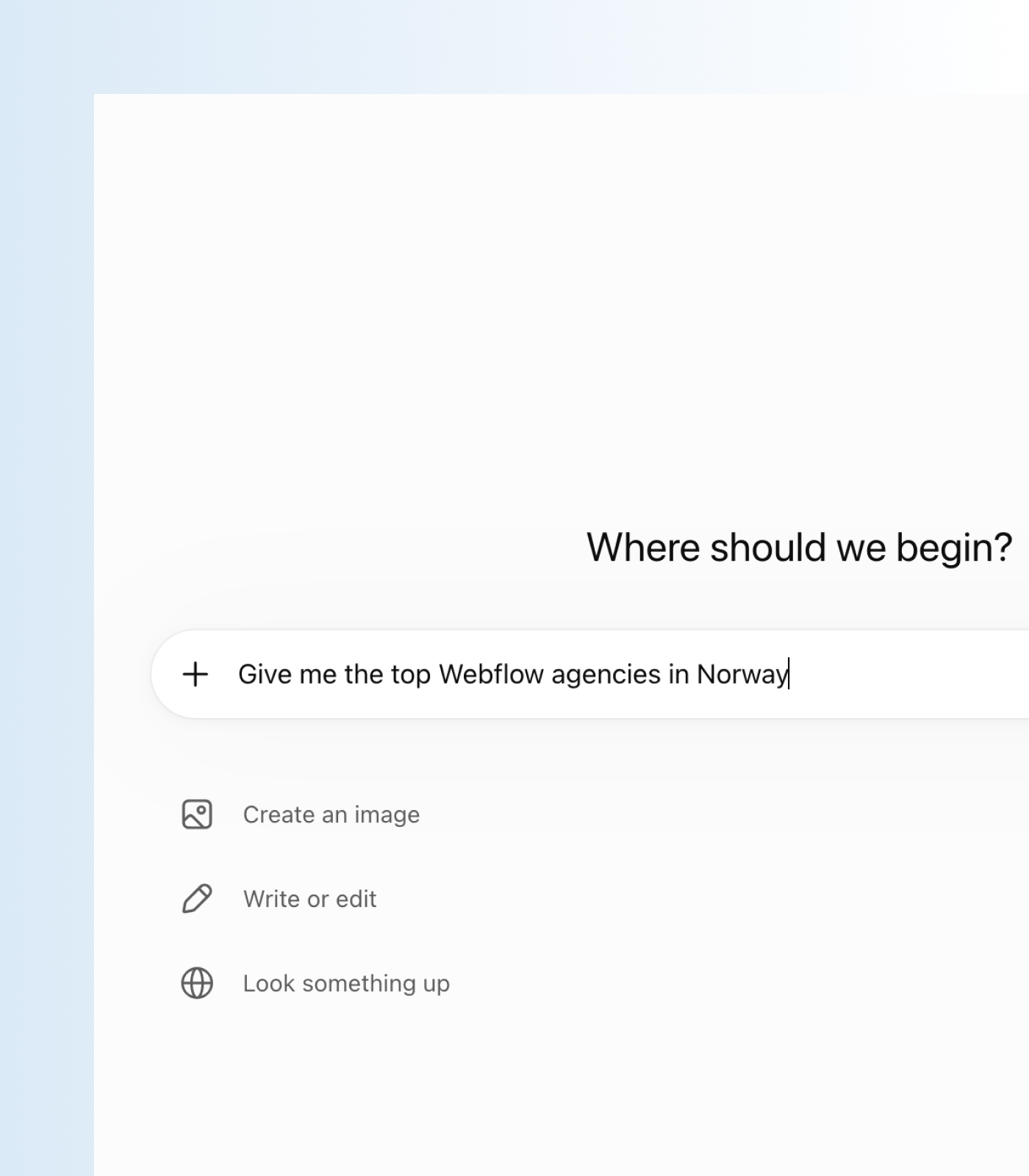
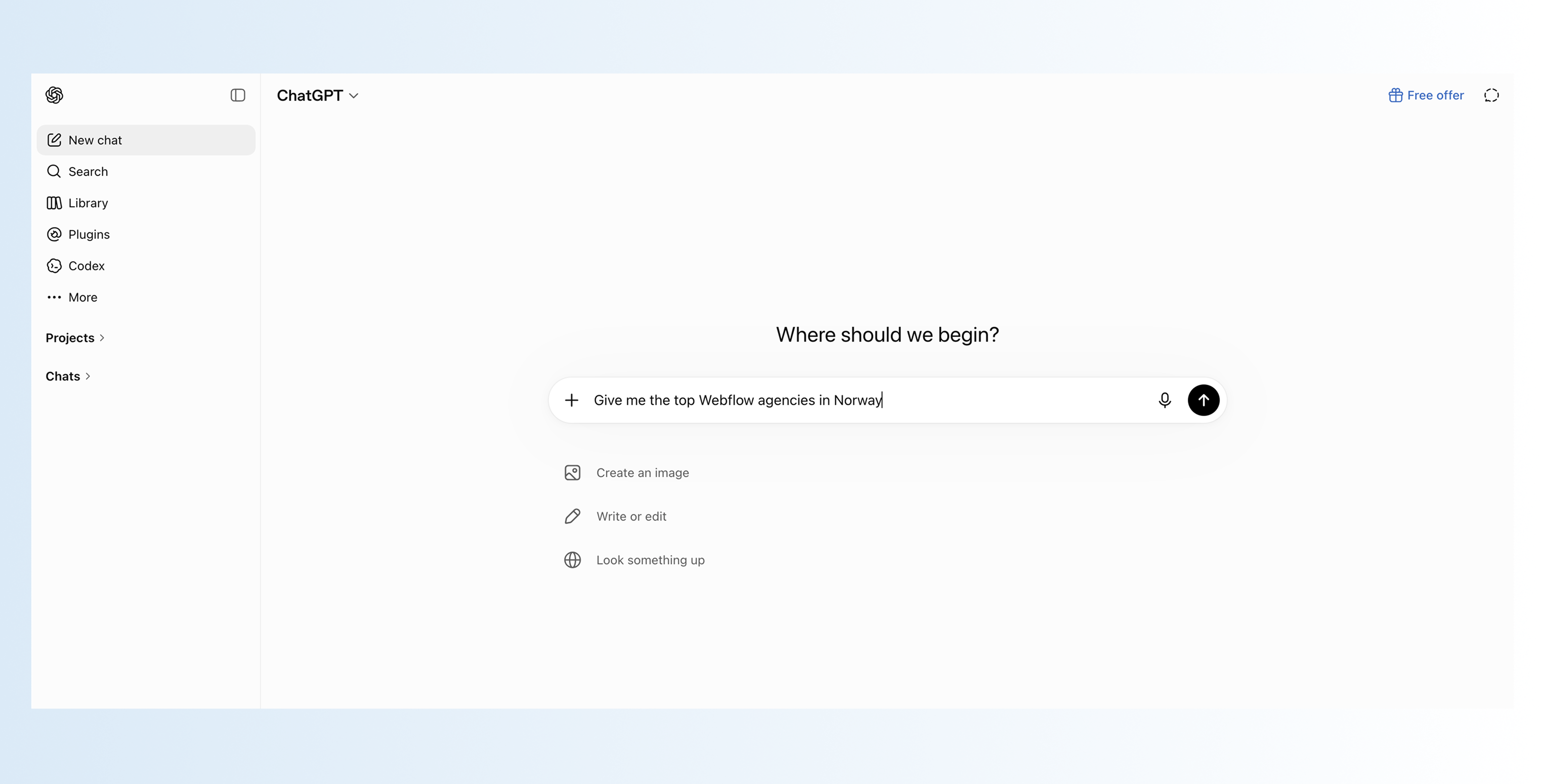
Answer Engine Optimization (AEO) is the practice of making your website easier for AI-powered search systems to understand, trust, and reference when generating answers. Unlike traditional SEO, which focuses on improving rankings in search engine results, AEO focuses on helping AI understand your content and accurately represent your business. Think about asking ChatGPT:
What's the best platform for building a marketing website?
Instead of showing ten blue links, the AI generates a complete answer. It decides which companies to mention, which platforms to recommend, and how to describe each option. Your website might contain exactly the information someone is looking for, but if AI struggles to understand your content, or doesn't consider it trustworthy, it may never include your business in its response. That's the goal of AEO: increasing the likelihood that AI systems understand your expertise, accurately represent your brand, and cite your content when answering users' questions.
You might ask: why does this matter?
The adoption of AI search is growing fast. Millions of people are already using AI tools to research products, compare services, solve problems, and make purchasing decisions. Instead of clicking through several websites, users increasingly expect one clear, trustworthy answer. This fundamentally changes how businesses earn visibility online. Traditionally, success meant ranking at the top of Google's search results. While rankings still matter, AI-powered search introduces another layer: being selected as a trusted source behind the answer. In many cases, users may never see a traditional search results page at all. Their first interaction with your business could be through an AI-generated summary. That means your content needs to do more than rank. It needs to communicate clearly, answer real questions, and demonstrate expertise that AI systems can confidently rely on.
What's the difference between SEO and AEO?
One of the biggest misconceptions is that AEO replaces SEO. It doesn't. In reality, AEO builds on strong SEO foundations. Search Engine Optimization helps search engines discover, crawl, and index your website. It focuses on elements like technical performance, keyword optimization, metadata, mobile usability, internal linking, and site structure. Answer Engine Optimization takes those foundations a step further by helping AI systems understand the meaning of your content and determine whether it's trustworthy enough to reference. A simple way to think about it is this:
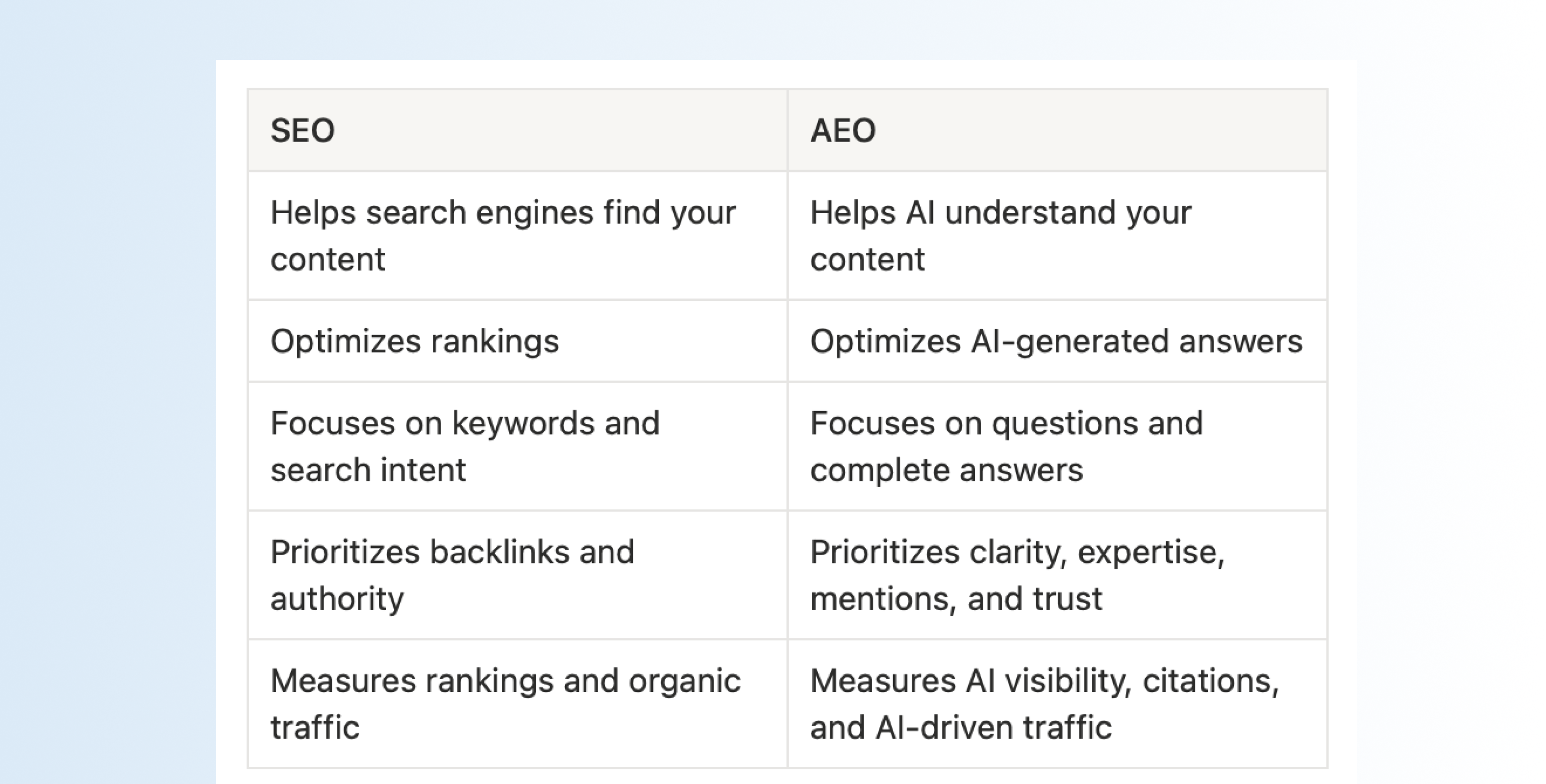
Perhaps the simplest way to remember the difference is: SEO helps your website get found. AEO helps your business get chosen. The good news is that if your website already follows SEO best practices, you're ahead of the curve. Fast loading speeds, semantic HTML, logical site structure, responsive design, and high-quality content all provide a strong foundation for AEO. The difference is that AI systems evaluate content differently. They prioritize clarity, context, freshness, and authority rather than relying solely on traditional ranking signals. As AI continues to shape how people discover information online, businesses that combine strong SEO with AEO will be better positioned to remain visible. Not just in search results but in the answers themselves.
The four pillars of Answer Engine Optimization
If SEO is about helping search engines discover your website, AEO is about helping AI systems understand and confidently reference it. Although AI-powered search is still evolving, most successful AEO strategies are built on the same four foundations:
- Content
- Technical foundations
- Authority
- Measurement
Together, these pillars determine how AI interprets your website, evaluates its credibility, and decides whether your content deserves to be included in generated answers.
1. Content: Answer questions
For years, SEO has focused heavily on keywords. Businesses optimized pages around phrases like "Webflow agency" or "website designer New York" in the hope of ranking higher in Google. While keywords still matter, AI search is changing the way people search. Instead of typing short phrases, users are asking complete questions:
How much does it cost to build a Webflow website?
Should I choose Webflow or WordPress?
How long does a website redesign take?
What should a startup website include?
AI systems are designed to answer these questions directly. If your website already provides clear, well-structured answers, it becomes much easier for AI to understand and reference your content.
Write for people first
One of the biggest mistakes businesses make is writing content purely for search engines. Instead, focus on helping your audience solve real problems. A good piece of AEO content should:
- Answer a specific question clearly.
- Explain the topic in plain language.
- Cover the subject in enough depth to be genuinely useful.
- Include examples where appropriate.
- Be easy to scan using descriptive headings and short paragraphs.
Think about the conversations you have with clients every day. Every recurring question is an opportunity to create valuable content.
Keep your content fresh
Freshness also matters. AI models tend to favour content that is regularly updated and reflects current information. An outdated guide from several years ago is less likely to be referenced than one that has been reviewed and improved recently. You don't always need to publish new articles. Updating existing pages with new information, examples, statistics, or screenshots can be just as valuable.
2. Technical Foundations: help AI understand your website
Great content alone isn't enough. Your website also needs to communicate its meaning clearly. Not just to visitors but to search engines and AI systems. Fortunately, many technical best practices for SEO also support AEO.
Use semantic HTML
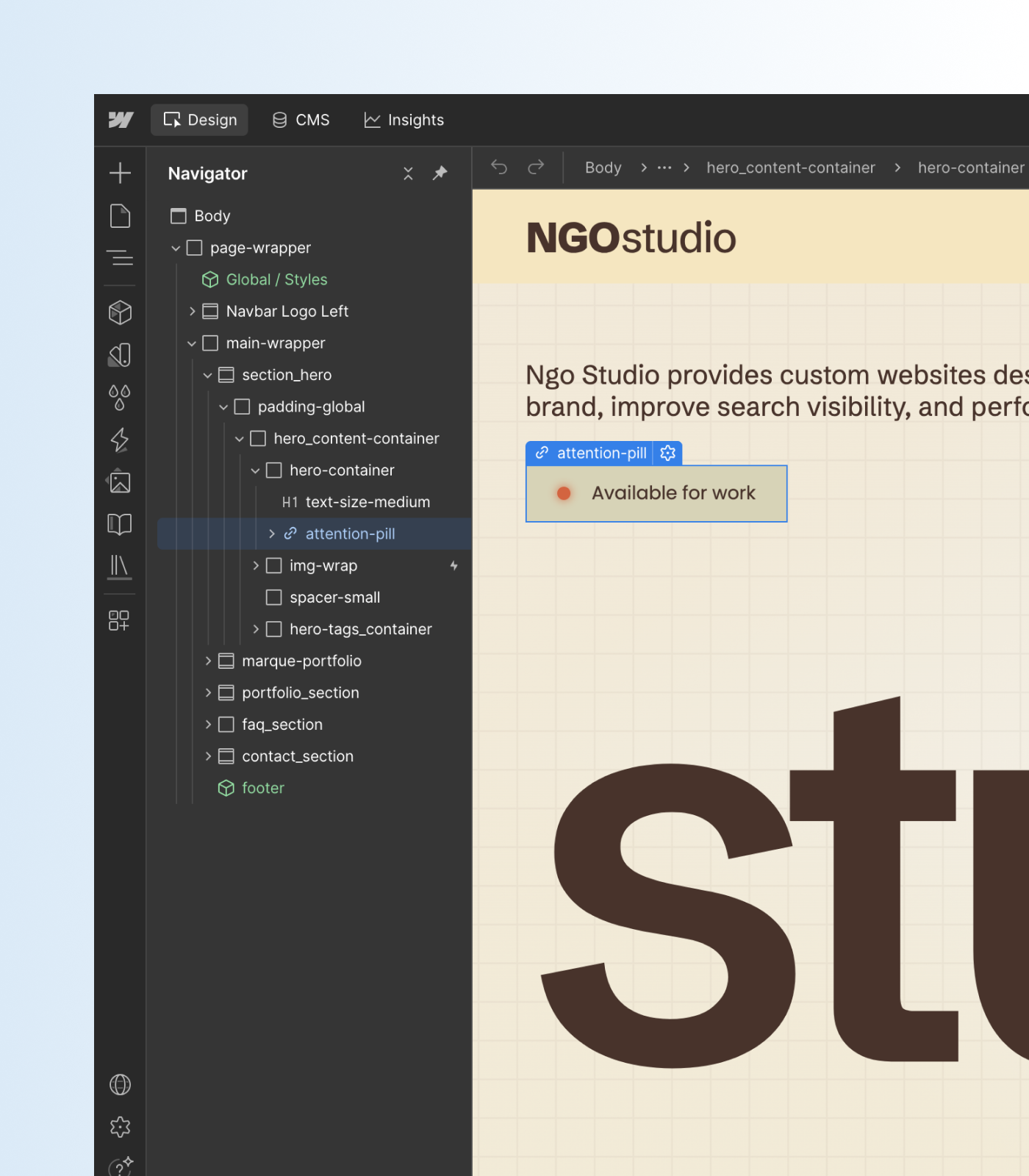
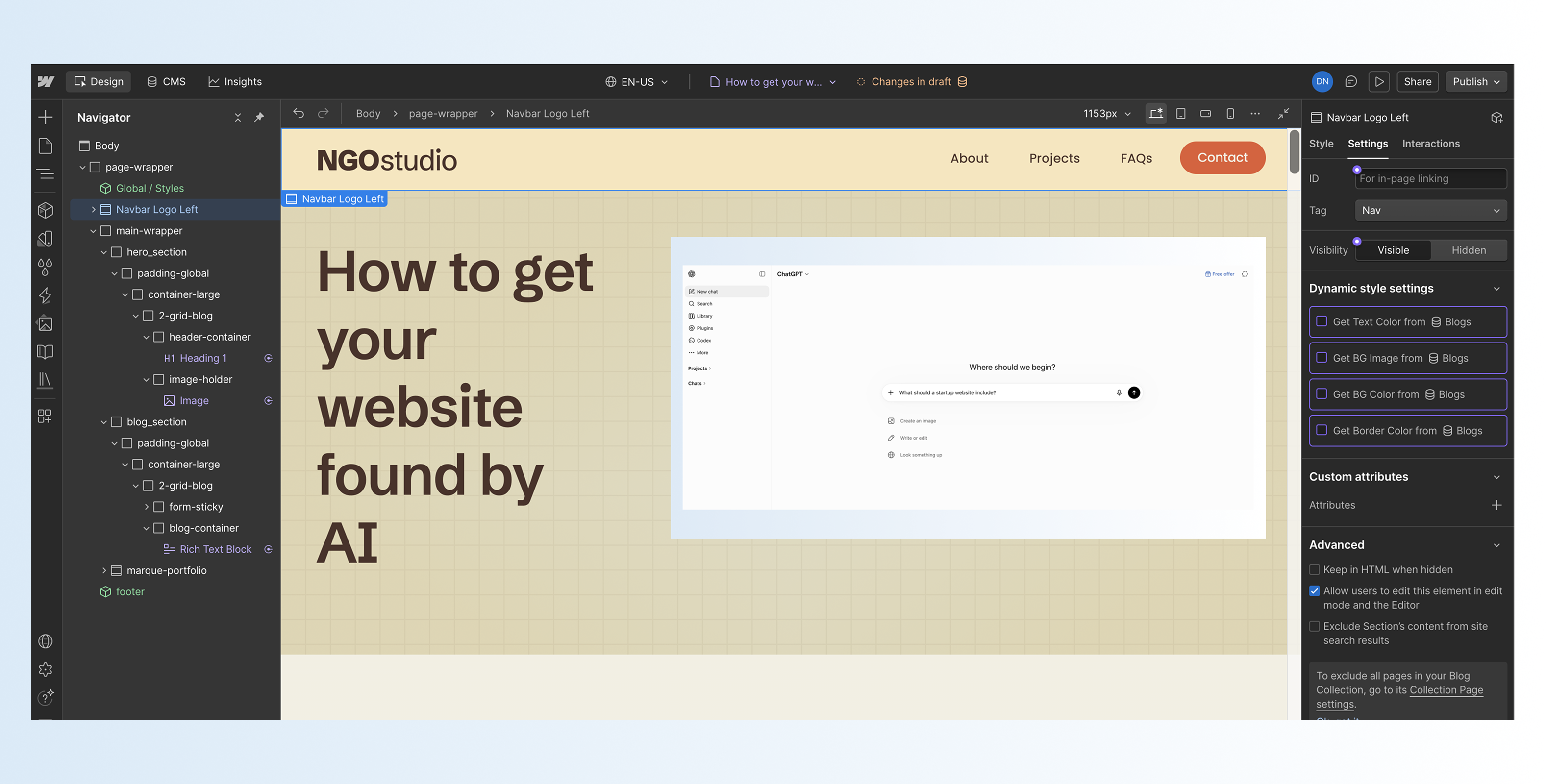
Semantic HTML gives structure and meaning to your content. Elements like <header>, <main>, <section>, <article>, and <footer> help AI understand the purpose of different parts of a page. Likewise, proper heading hierarchy (H1, H2, H3) creates a logical outline that makes it easier for AI to identify key topics and extract answers.
Create a logical site structure
Your website should be easy to navigate for both users and AI. Clear navigation, descriptive URLs, and strong internal linking help establish relationships between pages and reinforce topical authority. For example, if you offer Webflow development services, it makes sense to link related content such as:
- Webflow SEO
- Website performance
- CMS implementation
- Website maintenance
This helps AI understand that these topics belong to the same area of expertise.
Prioritize speed and accessibility
Fast websites create a better user experience, but they also improve how reliably AI systems can access and process your content. Focus on:
- Fast loading times
- Responsive design
- Optimized images
- Accessible navigation
- Clean, lightweight code
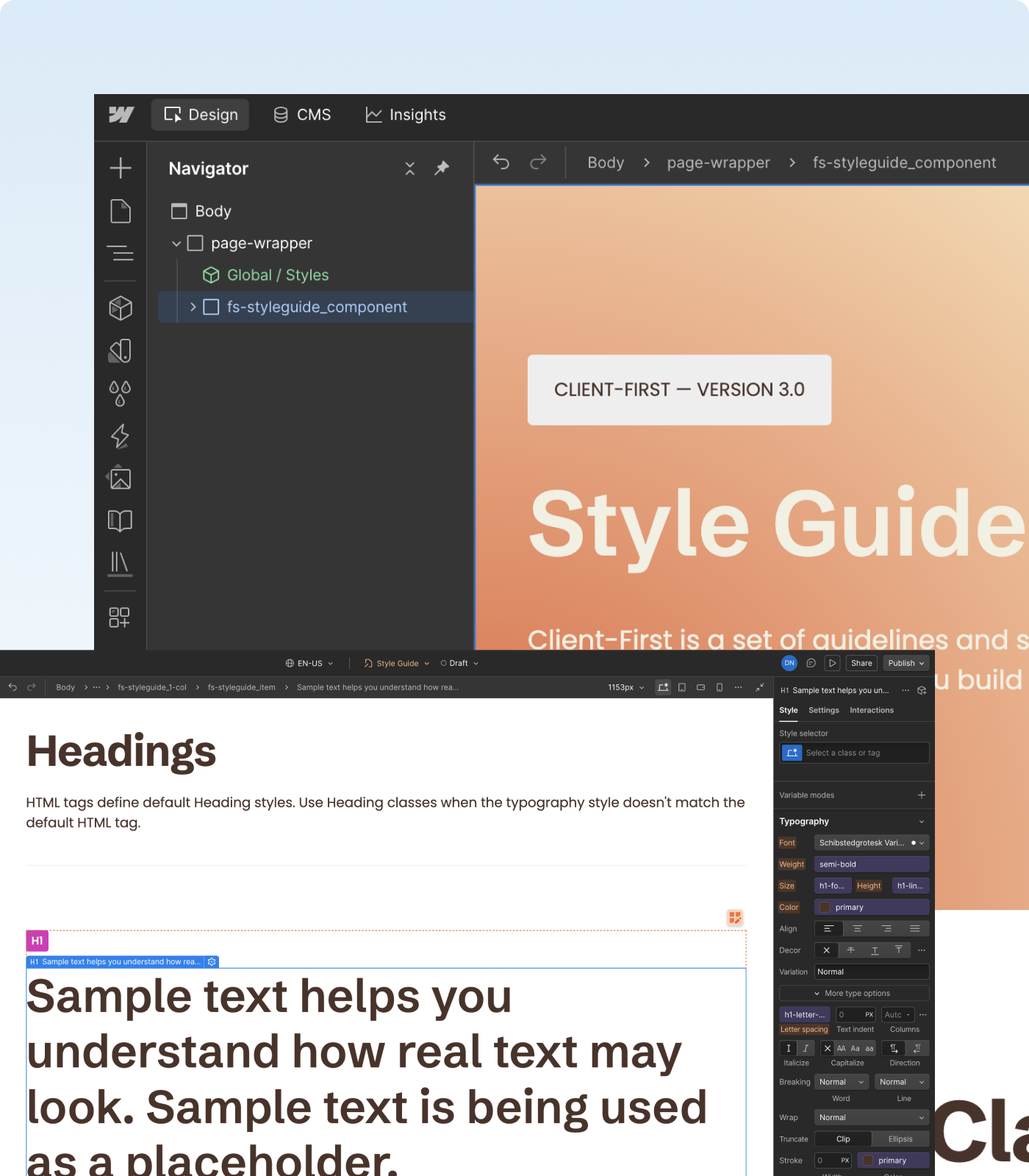
At Ngo Studio, we use the Client-First framework because it helps create websites that are scalable, maintainable, and easy for both humans and machines to understand.
Use structured data
Structured data (Schema.org) provides additional context about your website. It tells search engines and AI systems exactly what a page represents, whether that's:
- An article
- A service
- A local business
- An FAQ
- A product
- A person
Schema doesn't change what visitors see, it works behind the scenes to make your content easier to interpret.
Don't forget the basics
Strong AEO also depends on having your SEO fundamentals in place. These include:
- XML sitemap
- robots.txt
- Accurate metadata
- Descriptive page titles
- Meta descriptions
- Image alt text
These signals help search engines discover and understand your website, creating a stronger foundation for AI search.
What about LLMs.txt?
You may have heard about LLMs.txt, an emerging standard designed to help website owners communicate with AI systems. Unlike robots.txt, which tells search engine crawlers what they can or can't access, LLMs.txt is intended to guide AI models toward the most valuable parts of your website. While adoption is still in its early stages, it's worth keeping an eye on as AI search continues to evolve.
3. Authority: become a trusted source
One of the biggest differences between SEO and AEO is how authority is evaluated. Traditional SEO has long relied on backlinks as an important ranking factor. AI systems look beyond backlinks. They also consider how often your business is mentioned across the web and whether those mentions consistently describe your expertise. Think of it as your digital reputation. Authority can come from:
- Industry publications
- Podcasts
- Interviews
- Customer reviews
- Case studies
- Community discussions
- Original research
- Speaking engagements
The more consistently your brand appears in trustworthy places, the easier it becomes for AI to recognise you as an authority. This doesn't happen overnight. Authority is built through consistently publishing valuable content, sharing expertise, and contributing to conversations within your industry. For smaller businesses, this represents a significant opportunity. You don't need to be the biggest company, you simply need to become one of the most helpful and trusted voices in your niche.
4. Measurement: track what AI says about your brand
Traditional SEO metrics focus on rankings, impressions, clicks, and organic traffic. While those metrics are still valuable, they don't tell the whole story in an AI-driven search landscape. With AEO, success isn't measured by where your website ranks. It's measured by how often your brand appears in AI-generated answers, how accurately it's represented, and whether those mentions drive qualified traffic to your website.
Monitor AI-driven traffic
Platforms like Google Analytics can help you identify visitors coming from AI-powered tools such as ChatGPT, Perplexity, or Microsoft Copilot. Although referral data is still evolving, AI-generated traffic is becoming easier to track. Don't just look at the volume of traffic. Focus on the quality. Visitors arriving from AI tools often have a clearer intent and are further along in the decision-making process, which can lead to higher engagement and better conversion rates.
Evaluate your AI visibility
One of the simplest ways to measure your visibility is to use AI tools yourself. Ask the same questions your potential customers would ask, for example:
Who are the best Webflow agencies?
How much does a custom website cost?
What is Answer Engine Optimization?
Is Webflow good for SEO?
Then evaluate the responses. Ask yourself:
Does my business appear?
Is my expertise described accurately?
Which competitors are being mentioned?
Are there content gaps I could fill?
This manual process provides valuable insights into how AI currently understands your brand.
Treat measurement as a feedback loop
AEO isn't a one-time project. As AI search continues to evolve, your website should evolve with it. Use what you learn to continuously improve your content, update outdated pages, strengthen your authority, and refine your technical foundations. The goal isn't simply to publish more content. It's to publish better and more helpful content for your customers.
Questions every business should ask
As you begin thinking about AEO, these questions can help identify where to focus your efforts:
Content
Are we answering the questions our customers actually ask?
Does our content fully cover the topics we're known for?
Is our information current and accurate?
Technical
Is our website easy for AI to understand?
Do we use semantic HTML and proper heading structure?
Have we implemented structured data where it makes sense?
Authority
Where is our brand mentioned online?
Do those mentions accurately describe what we do?
Are we sharing our expertise beyond our own website?
Measurement
How do AI tools currently describe our business?
Which questions would we like AI to answer using our content?
Are we seeing qualified traffic from AI-powered search?
Search isn't disappearing, it's evolving
Google remains an important source of traffic, but AI-powered search is changing how people discover businesses and make decisions. Instead of browsing multiple websites, users increasingly expect clear, trustworthy answers generated by AI. That doesn't mean SEO is becoming less important. In fact, strong SEO has never mattered more. Fast websites, clean code, logical site structure, high-quality content, and technical best practices remain the foundation of online visibility. Answer Engine Optimization builds on that foundation. By creating genuinely helpful content, strengthening your technical implementation, building authority, and measuring how AI represents your brand, you'll be better positioned for the future of search.
The businesses that succeed won't be the ones chasing AI hacks or quick wins. They'll be the ones consistently publishing useful content, demonstrating expertise, and making it easy for both people and AI to understand what they do. If your website already follows SEO best practices, you're off to a great start. The next step is making sure AI understands your business just as well as your customers do.